

Phase‑Appropriate GMP Framework
EXECUTIVE SUMMARY:
Lupin Manufacturing Solutions Limited (LMSL), a wholly owned subsidiary of Lupin, has been a trusted partner in the CDMO space, supporting global pharmaceutical innovators with high‑quality, compliant, and efficient drug substance development. As CDMO projects increasingly span multiple development stages—from preclinical to commercial —LMSL identified an opportunity: for developing unified, clear, and practical framework for meeting phase‑appropriate GMP requirements.
To address this, LMSL conceptualized and deployed a Phase‑Appropriate GMP Framework, establishing a risk based, structured, scientific, and regulatory‑aligned model that harmonizes development speed with compliance. This initiative strengthens LMSL’s capabilities to deliver faster, safer, and more predictable project outcomes for global innovator customers for multiple therapeutic segments.
PROBLEM STATEMENT:
While working on CDMO projects at various stages of development—whether intended for clinical or preclinical phases—it is evident that applying a uniform level of GMP across all development stages can limit agility in drug development. Pharmaceutical development often face uncertainty in determining the appropriate extent of GMP controls required for each phase. Excessive controls too early or insufficient controls later can result in delays, inconsistencies, deviations, and compliance challenges. This misalignment leads to;
- Prolonged documentation cycles
- Inefficient cross-functional collaboration
- Higher deviation rates due to unclear expectations
- Increased regulatory and compliance risks
- Delay in project deliverables and misalignment with customer expectations
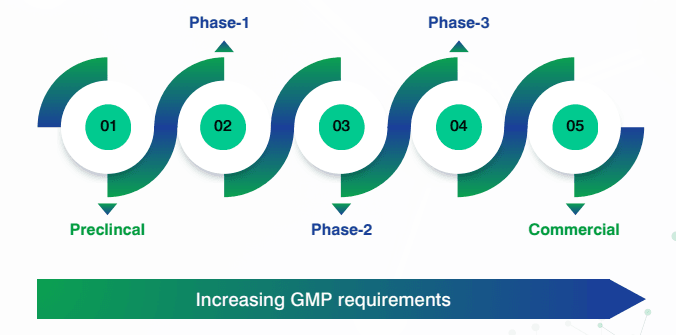
A tailored GMP approach became essential to balance regulatory compliance with the flexibility needed for innovation and timely progression of drug developmental phases. With no single guideline clearly defining phase‑appropriate GMP, initiated this effort to develop a harmonized, practical and clear framework. Through a scientific, risk‑based methodology, consolidated regulatory expectations and available guidance to create a concept paper that enables CDMO projects to advance with speed, compliance and clarity during execution.
DESIGN AND APPROACH:
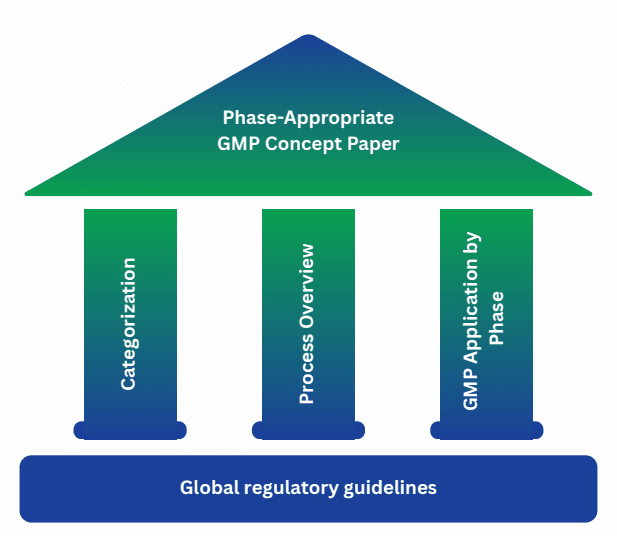
The Phase‑Appropriate GMP Framework is built on three foundational pillars:
-
Categorization Based on Development Stage:
GMP requirements increase from preclinical to commercial stages as process knowledge and product risk grow. Early phases emphasize basic safety and traceability with minimal controls and flexible parameters supported by risk‑based decisions. As development progresses into Phase III, process understanding is robust, CQAs are established, and tighter specifications demand stronger controls and validated processes. At the commercial stage, full GMP compliance is mandatory, supported by validated systems, comprehensive documentation, and a mature quality framework forming the basis for defining all categories accordingly.
-
Process Overview: Development to Commercialization
All CDMO project lifecycle processes from project award, early development through lab optimization, pilot execution, process and analytical validation and commercial manufacturing, were consolidated into a single integrated workflow. This mapping aligned GMP expectations with the scientific maturity of each phase, ensuring controls were applied appropriately at every stage. The framework provided clear visibility across R&D, pilot plant, and GMP manufacturing operations, strengthening cross‑functional accountability and reducing inefficiencies arising from unclear roles or process overlaps.
-
cGMP Application by Phase :
Various regulatory guidelines providing clarifications on GMP requirements w.r.t preclinical and clinical phase were collated as mentioned below and the respective phase wise requirements were established.
| Regulatory Guidance | Title |
|---|---|
| ICH Q7 | Good Manufacturing Practice Guide for Active Pharmaceutical Ingredients (Section 19) |
| ICH Q8 | Pharmaceutical Development |
| ICH Q9 | Quality Risk Management |
| ICH Q10 | Pharmaceutical Quality System |
| PE 009-17 (Part II) | Guide to Good Manufacturing Practice for Medicinal Products – Part II (Basic Requirements for Active Pharmaceutical Ingredients) |
| FDA Docket No.: FDA‑2005‑D‑0157 | Current Good Manufacturing Practice for Phase |
| WHO Technical Report Series (TRS) No. 1044, Annex 7 (2022) | WHO Good Manufacturing Practices for Investigational Products” (Annex 7) |
| APIC “How to do” Document – Interpretation of ICH Q7 (Version 15) | |
| Detailed Commission guidelines on good manufacturing practice for investigational medicinal products for human use, pursuant to the second subparagraph of Article 63(1) of Regulation (EU) No 536/2014. | |
Once these are summarized, a consolidated matrix was designed on Phase appropriate GMP, defining requirements at each stage aligned to the above framework.
PHASE-SPECIFIC GPM APPLICATION MATRIX:
A comprehensive matrix, derived from global guidelines (ICH, FDA, EU, WHO), consolidates expectations into a single practical reference—something no single guideline currently provides.
This matrix defines documentation, controls, risk activities, and permissible flexibilities at each phase. Refer to the below:
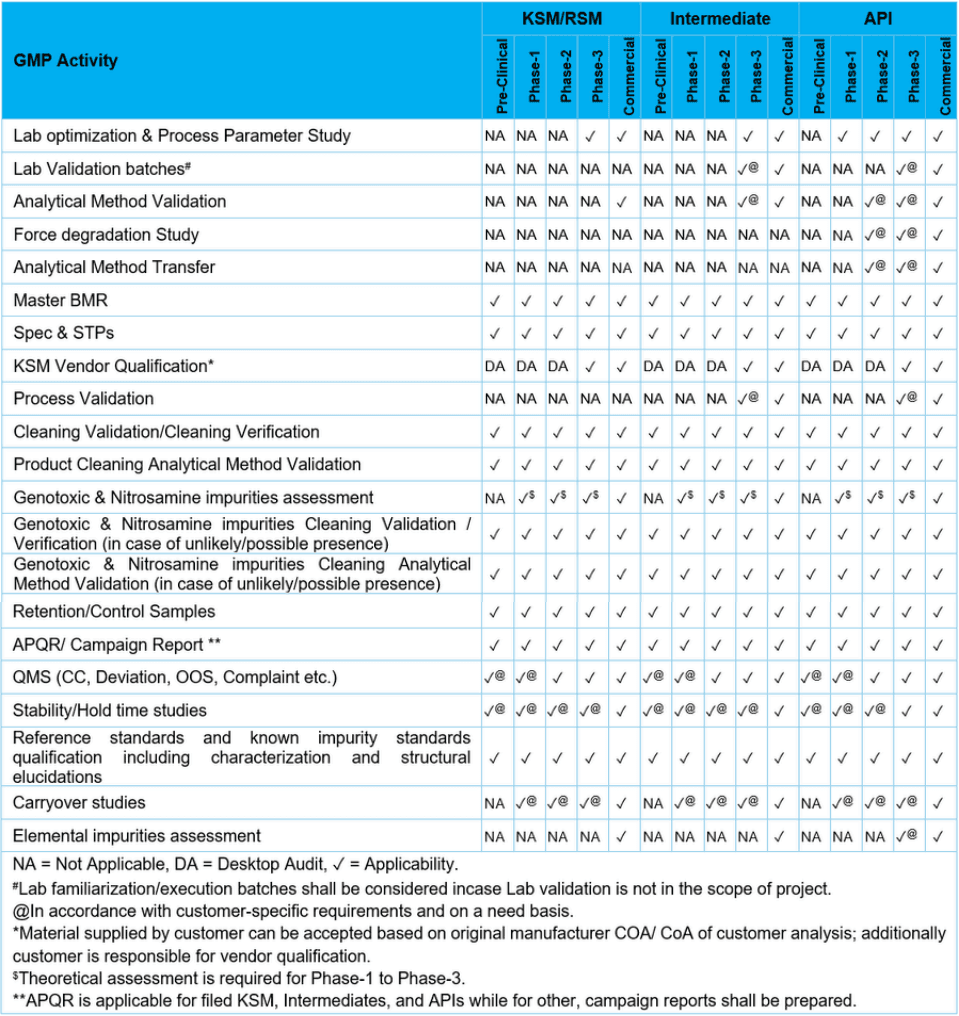
Disclaimer: This matrix has been developed based on internal experience/use case and reference to various guidance documents. Any unauthorized use, sharing or distribution is strictly prohibited.
DIFFERENTIATION & FUTURE-READINESS:
The framework shifts GMP decision‑making from subjective, person‑dependent judgement to a consistent, system‑driven model, ensuring clarity across all development stages. It enables faster, more flexible early‑phase execution without compromising patient or product safety, while resolving operational inefficiencies such as prolonged documentation cycles, delays, and ambiguity that were leading to overall delay of project executions.
By clearly defining phase‑appropriate expectations, it strengthened cross‑functional collaboration, reduced regulatory and compliance risks, and ensured predictable project delivery aligned with customer needs.
Fully harmonized with global regulatory principles, the approach provides a future‑ready blueprint for seamless scale‑up, technology transfer, and commercialization of manufacturing processes. Its scalability across diverse molecules, customer programs, and emerging technologies ensures long‑term organizational adaptability and sustained value creation.
IMPACT, MEASURABLE OUTCOMES:
Implementation of this framework has delivered significant improvements.
- Enhanced agility in drug development
- Accelerated the development and delivery of NCEs, enabling innovators to bring new drugs to patients faster.
- Operational & Compliance Benefits
- Reduced documentation cycle times through phase‑wise standardization.
- Minimized project delays by providing clear, stage‑specific expectations.
- Strengthened audit readiness across all development phases.
- Execution Efficiency (utilizing matrix)
- Improved cross‑functional collaboration and accountability.
- Faster decision‑making, and fewer alignment gaps.
- Accelerated project timelines, resulting in improved customer satisfaction.
- Quality & Risk Management
- Enhanced product integrity and operational efficiency.
- Improved resource efficiency by eliminating excessive early‑phase controls.